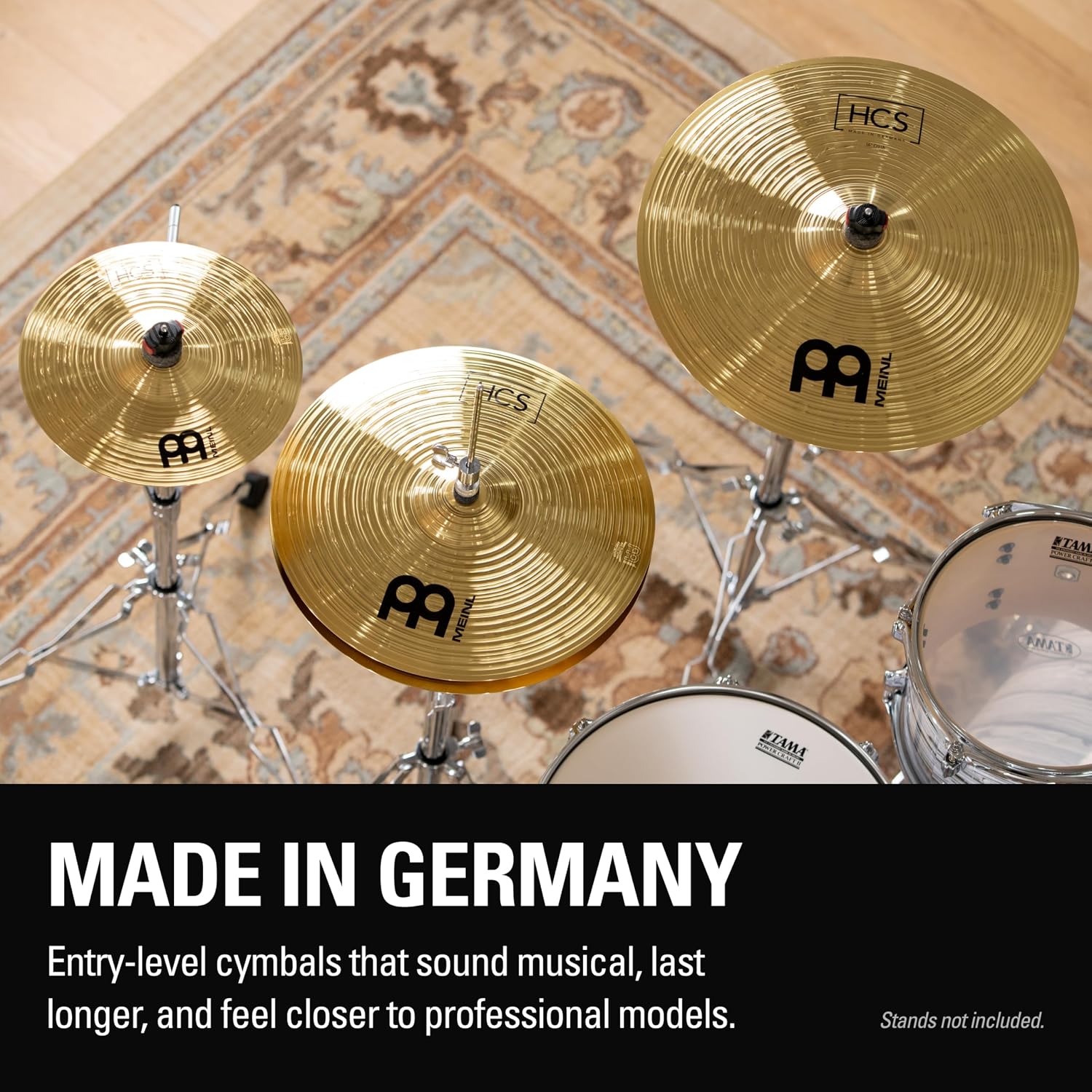
Cymbals are the brass (or bronze) discs mounted around a drum kit that produce the shimmer, crash, and ride sounds you hear cutting through nearly every style of music. They come in a few standard roles: a hi-hat is a pair of cymbals controlled by a foot pedal that produces a tight “chick” or open “tshhh”; a crash is the wide, explosive accent cymbal; and a ride is the larger, darker cymbal used for steady rhythmic patterns. Manufacturers sell these in cymbal packs — pre-bundled sets that combine two or three of those roles at a single price — and the pitch is simple: buy together, save money versus buying each piece separately. That pitch is sometimes true and sometimes fiction. This guide breaks down how to calculate the actual price-per-piece value of popular packs at the intermediate level, names the sets where the math works in your favor, and tells you which bundles you should walk away from.
| EDITOR'S PICKSABIAN HHX Complex Cymbal Set P… | Mid-tierMeinl Cymbal Set Box Pack with… | Budget pickMeinl Cymbal Set Box Pack with… | |
|---|---|---|---|
| Cymbal count | — | 4 | 4 |
| Hihat size | — | 14" | 14" |
| Ride size | — | 20" | 20" |
| Crash size | — | 16" | 16" |
| Free cymbal | — | ✓ 18" Crash | ✓ 10" Splash |
| Material | — | — | Brass |
| Price | $1,524.99 | $669.99 | $279.99 |
| See on Amazon → | See on Amazon → | See on Amazon → |
Why Price-Per-Piece Math Matters More Than the Bundle Discount
The bundle discount number — “save $180 when you buy the pack!” — is almost always calculated against the manufacturer’s suggested retail price (MSRP), which is a number manufacturers set high on purpose. Street price (what you actually pay at most retailers) is often 20–35% below MSRP before a pack discount is even applied. So when a brand advertises 25% off on a bundle, they may be measuring 25% off a number nobody was ever going to pay.
The real calculation is simpler: divide total pack price by the number of pieces, then compare each piece to its individual street price. If the pack gives you a genuine per-piece discount against real street prices — and none of the included pieces are ones you’d never buy on their own — it’s a legitimate value. If the math only closes because one of the pieces is a 10” splash you didn’t want, you’re not saving money; you’re buying filler.
Drumhead Magazine’s cymbal pack analysis notes this exact pattern: budget-tier packs frequently inflate value by including smaller-diameter pieces (10” or 12” splashes, thin 16” crashes) that carry low individual street prices but pad the piece count. The per-piece average looks healthy; the usable per-piece average does not.
A Quick Price-Per-Piece Comparison
| Pack | Street Price (2026) | Pieces | Price/Piece | Usable Pieces* |
|---|---|---|---|---|
| Zildjian A Custom Box Set (14HH/16Cr/20Rd) | ~$649 | 3 | $216 | 3 |
| Sabian B8X Performance Set (14HH/16Cr/20Rd) | ~$229 | 3 | $76 | 3 |
| Meinl HCS Complete Set (14HH/16Cr/18Cr/20Rd) | ~$179 | 4 | $45 | 3–4 |
| Zildjian K Custom Dark Set (14HH/17Cr/19Cr/21Rd) | ~$1,149 | 4 | $287 | 4 |
| Sabian HHX Evolution Cymbal Set (14HH/16Cr/18Cr/21Rd) | ~$989 | 4 | $247 | 4 |
*“Usable” defined as pieces a working intermediate player would likely keep on the kit permanently.
The Packs That Actually Hold Up
Zildjian A Custom Box Set is the benchmark recommendation across several sources for the intermediate-to-advancing player, and the math justifies the reputation. Sweetwater’s cymbal buying guide points to the A Custom line as one of the clearest cases where pack pricing reflects real savings: the 14” hi-hats, 16” crash, and 20” ride purchased individually would run roughly $730–$760 at street price. The pack routinely prices at $629–$649, making the discount genuine rather than MSRP theater. More importantly, every piece in this set is one you’d choose individually. There’s no filler.
What owners consistently report in long-run reviews — across forums aggregated by MusicRadar — is that A Customs hold their resale value unusually well for the price tier. The bright, cutting voicing translates across genre contexts (rock, pop, R&B, session work), which means if you ever part with a piece, you’re not selling a niche item. From a gear-as-infrastructure standpoint, that matters.
Sabian HHX Evolution Set earns its price at the higher end of intermediate spending. The four-piece configuration (14” hi-hats, 16” crash, 18” crash, 21” ride) gives you a genuinely complete setup without redundancy. Sound On Sound’s coverage of the HHX line notes the Evolution voicing — relatively dry, quick decay, strong stick definition — as a serious production-friendly characteristic that crossover producers and live drummers both cite. Individual street prices on HHX pieces put this set’s savings at roughly $120–$150 versus buying separately. That’s real.
Sabian B8X Performance Set deserves mention in a separate category: it’s not a premium pack, but it’s the rare budget option where the math is honest. Three genuinely useful pieces, no splash filler, and the B8X alloy (a brass-based composition rather than professional-grade B20 bronze) is disclosed rather than buried in fine print. Drumhead Magazine’s entry-level cymbal coverage treats it as a legitimate stepping stone rather than a cynical starter bundle. If you’re at the stage where you need to put something on the kit while saving for the upgrade, this won’t embarrass you.
The Money Pits: Where the Math Breaks Down
Generic “complete” packs from house brands — the ones bundled with entry-level drum kits from Amazon-tier drum brands — almost universally fail the per-piece test. The strategy is straightforward: include a hi-hat, a crash, a ride, and a 10” splash, price the set at $149, and let the four-piece count imply value. The individual splash retails for $19. You needed three usable pieces; you paid for four and got three.
This isn’t speculation — MusicRadar’s best cymbal packs guide explicitly flags this category as one to avoid even when the budget is tight, recommending that players stretch to used name-brand individual cymbals over new no-brand packs.
Oversized “Pro” bundles from mid-tier lines represent a subtler trap. Packs that include six or seven pieces — two crashes, a china, an effects cymbal, hi-hats, and a ride — at a combined price that looks impressive can still fail the math test if most of those pieces would be set aside within six months. A china cymbal and an 8” splash are legitimate tools for specific styles, but if your playing context is straight-ahead rock or jazz, you’re funding pieces you won’t use. The per-piece average flatters the pack; your actual cost-per-used-piece is higher.
The Meinl HCS Complete Set sits in a nuanced middle position. The bronze-steel alloy construction is honest for the price, and the four-piece configuration is genuinely usable. But the voicing — bright, slightly harsh sustain — tends to prompt upgrades quickly, meaning you’re often spending this money twice. If you’re buying this as a placeholder and know it, that’s a clear-eyed decision. If you’re buying it expecting to stay there for two years, owner reviews consistently suggest that timeline is optimistic.
Hidden Costs the Pack Price Doesn’t Include
This is where a lot of intermediate buyers get caught. The pack price covers the cymbals. It doesn’t cover:
- Cymbal stands: A solid hi-hat stand runs $80–$150; crash stands $50–$100 each; a boom stand for the ride another $60–$120. A full cymbal setup from scratch can require $300–$500 in hardware before a single cymbal is mounted.
- Wing nuts and felts: Every cymbal mount requires felt washers above and below the cymbal to protect the bell, plus a wing nut to secure it. These wear out and are often not included with packs. Budget $15–$30 for a complete set of replacements.
- Cases: Unprotected cymbals transported casually develop keyhole cracks at the bell and edge chips that destroy resale value and eventually compromise structural integrity. A quality cymbal bag runs $40–$80; hard cases more.
- The “one more” problem: Most three-piece packs leave you wanting at minimum one additional crash at a different size. Budgeting only the pack price and discovering you need a 17” or 18” crash six weeks later is an extremely common intermediate-level experience.
Sweetwater’s cymbal buying guide specifically flags the stand cost as the most frequently underestimated associated expense for players buying their first quality cymbal set.
The Decision Rule
The math here reduces cleanly to a few honest if/then frames:
If you’re spending $500–$800 and want a complete, giggable setup: The Zildjian A Custom Box Set or Sabian HHX Evolution Set are the defensible choices. Both pass the per-piece test against real street prices, both include zero filler, and both hold resale value well enough that you’re not destroying equity if you upgrade a piece in 18 months.
If you’re spending under $300 and need something functional right now: The Sabian B8X Performance Set is the honest choice. Know what the alloy is, know the ceiling on the sound, and plan the upgrade path. Don’t buy a six-piece generic pack at the same price and convince yourself the piece count is value.
If you’re at the $1,000–$1,200 range and considering professional-tier packs: Evaluate the Zildjian K Custom Dark Set or Meinl Byzance packs piece by piece against individual street prices in your specific configuration. At this price point, the differences in voicing between a 20” and 21” ride, or a 17” versus 18” crash, matter enough that buying a pack configured for someone else’s preferences is a real risk. Individual buying becomes more defensible here — used K Customs and Byzance pieces move regularly on the secondary market at 50–65% of street, which is favorable math for patient buyers.
If a pack includes any piece you wouldn’t buy individually: Run the math excluding that piece. If the remaining pieces still clear a 10–15% discount versus individual street prices, the pack may still be worth it. If the math only works because of the filler, walk away and buy the pieces you actually want.
The bundle discount is real when it’s real. The skill is learning to read the actual numbers instead of the marketing ones — which, at this stage of your drumming, is the same skill you’re applying to every piece of gear on the kit.