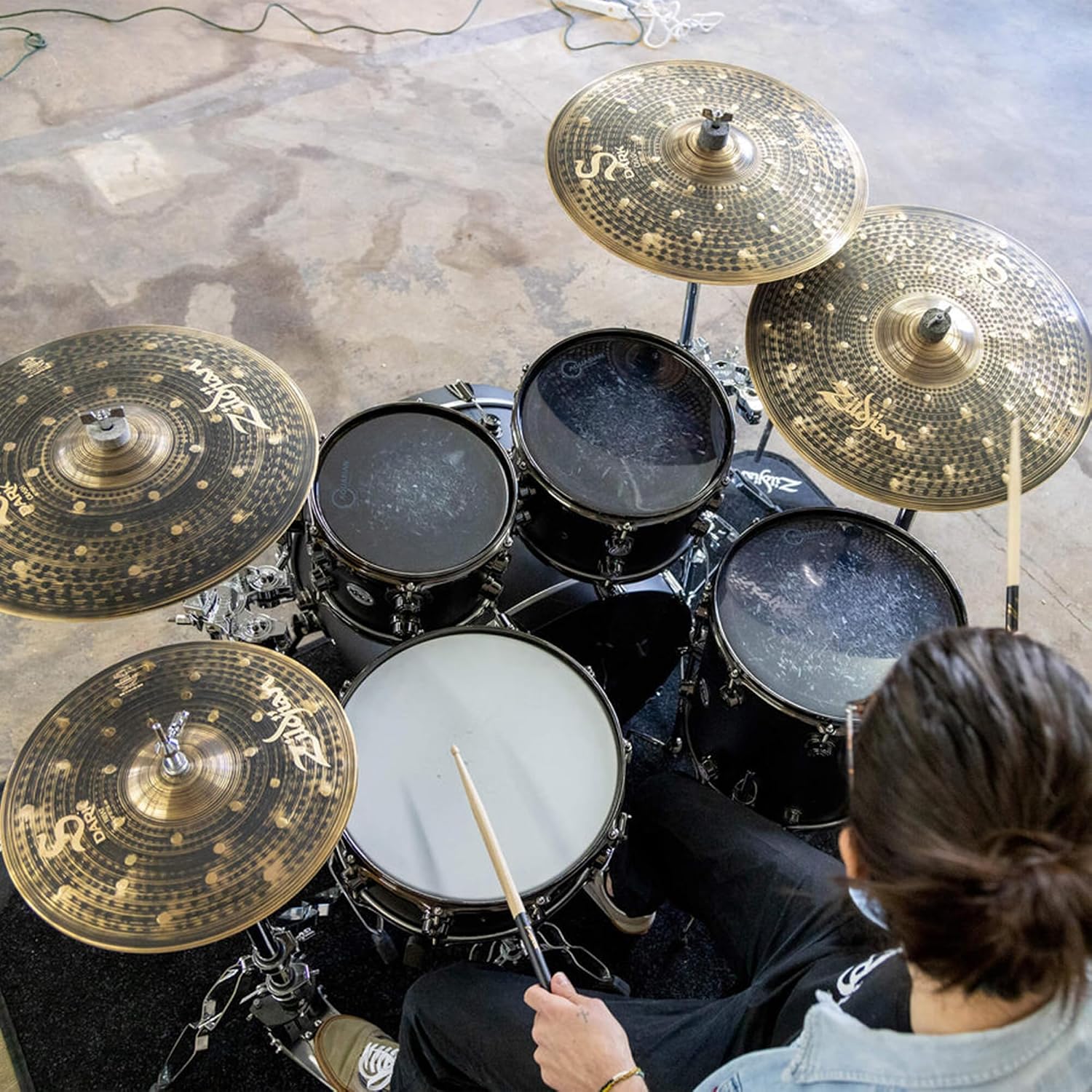
Your starter cymbal pack did its job. It got you through lessons, first rehearsals, maybe a few gigs — but somewhere around month eight or year two, you started noticing the gap. The crashes sound thin and washy instead of full and cutting. The hi-hats (the two cymbals stacked on a stand that open and close with a foot pedal) feel stiff and harsh, not crisp. The ride (the larger cymbal you use to keep steady patterns, usually on the right side of the kit) blurs into one muddy wash instead of giving you a clear “ping” on the bow and a controlled shimmer in the bell. That gap you’re hearing is real, and it has a name: the difference between entry-level brass and professionally cast B20 bronze. This article is for the player standing at that crossroads — someone with a feel for the instrument but still building the gear intuition to spend $400–$900 wisely. We’ll name the packs worth your money, show you the tradeoffs, and give you a clear decision rule at the end.
Why the Material Jump Matters More Than You Think
Almost every budget starter cymbal is stamped from sheet brass (copper + zinc). It’s fast to manufacture, forgiving to produce at scale, and cheap. The problem is that brass has a relatively narrow tonal range — it gets loud fast, cuts off quickly, and doesn’t have much going on in the mid and high-frequency complexity that gives professional cymbals their “voice.”
The industry standard for pro and semi-pro cymbals is B20 bronze — an alloy that’s 80% copper and 20% tin. Sweetwater’s Cymbal Buying Guide explains the significance clearly: B20 produces a wider frequency spread, longer sustain, and richer harmonic content than brass. Translation: your crashes bloom, your ride develops a genuine stick “ping,” and your hi-hats have that layered chick-and-sizzle texture you hear on recordings.
There’s also B8 bronze (92% copper, 8% tin), which lands between brass and B20. Several mid-tier packs use B8 — it’s not a bad material, but reviewers at MusicRadar consistently note that B20 packs in the same price range outperform B8 on warmth and complexity when comparing directly side by side.
The other variable is manufacturing method. Entry-level cymbals are machine-stamped — a press punches the shape out of sheet metal, done in seconds. Professional cymbals are cast (molten metal poured into a mold), then hammered by hand or machine. Cast and hand-hammered cymbals develop uneven surface texture that produces complex, layered overtones instead of a single harsh frequency. MusicTech’s overview of Zildjian’s A Custom line points to the hand-hammering step as the direct reason the series has become a recording-studio standard.
The Packs Worth Knowing (and What the Math Actually Looks Like)
Here’s where the value conversation gets specific. Most mid-tier pack options in 2026 cluster around two buying approaches: individual-cymbal packs (usually 14” hi-hats + one or two crashes + a ride, bundled at a discount) and cymbal sets sold as a complete upgrade bundle. The three lineups that dominate forum discussions and aggregated owner reviews right now are the Zildjian A Custom, Sabian HHX, and Meinl Classics Custom Dark.
By the numbers (mid-2026 street prices, standard 4-piece packs):
| Pack | Material | Typical Street Price | Best For |
|---|---|---|---|
| Zildjian A Custom Box Set | B20 cast | ~$750–$900 | Rock, pop, studio versatility |
| Sabian HHX Evolution Pack | B20 cast | ~$700–$850 | Jazz-leaning, dark/complex tones |
| Meinl Classics Custom Dark Set | B20 cast | ~$600–$750 | Dark, washy modern styles |
| Paiste PST X Swiss Pack | B8 bronze | ~$300–$400 | Budget B-list, louder genres |
Prices sourced from aggregated retailer listings as of May 2026. Individual configuration pricing varies.
Zildjian A Custom is the industry-standard comparison point for a reason. MusicTech’s coverage of the line describes it as one of the most recorded cymbal series in modern popular music — studio session drummers have kept it relevant for decades because it sits well in a mix without requiring heavy EQ. The bright, clean attack on the crashes and the dry, clear ping on the ride make it genre-flexible. Owners in long-run forum discussions frequently describe it as the pack they “grew into” rather than grew out of — which matters a lot for resale value (more on that below).
Sabian HHX Evolution is the serious competitor for players who want more complexity and darkness in their tone. Sound On Sound’s review of the HHX Evolution series highlights the hand-hammered and machine-hammered combination that gives the hi-hats an almost orchestral layered response. If you’re playing jazz, funk, R&B, or any style where the hi-hat is doing expressive, nuanced work rather than just timekeeping, owner reports consistently place HHX above A Custom in that register. The tradeoff: in loud rock or metal contexts, the darker character can get lost in the mix.
Meinl Classics Custom Dark is the sharpest value proposition at the sub-$750 range. Drumhead Magazine’s gear coverage positions it as the first “genuinely pro-feeling” entry point for drummers coming out of budget brass, with a particular strength in darker, more washy genres — think indie rock, alternative, post-rock. The lathed (meaning cut with grooves) surface reduces high-frequency harshness. The knock against it in owner discussions: the crashes can feel a little slow to open compared to Zildjian and Sabian at similar weights. For drummers who want fast, cutting crashes, that matters.
The Hidden Costs Nobody Puts in the Pack Price
This is the part that trips up even experienced mid-tier buyers. The pack price is not your total cost. Here’s what typically doesn’t come in the box:
Cymbal felts and sleeves. These are the small felt washers and plastic tubes that protect the cymbal hole from metal contact with the stand. They’re $5–$15 to replace, but they wear out — and a missing sleeve will crack a cymbal over time. Budget $20 for a full set of replacements when you buy new.
Stands. If your current hi-hat stand, cymbal stands, or boom arms were included in a beginner kit, they’re likely rated for lighter-duty use. B20 cymbals are heavier than stamped brass, and owners consistently report that cheap stands with loose clutch systems cause buzz and unwanted vibration that muddies the sound. A single quality boom arm (Gibraltar, DW 9000 series, Pearl Roadshow) runs $60–$120. If you’re adding a second crash, budget for at least one new stand.
Bags or cases. A mid-tier cymbal pack is an investment worth protecting from road damage. Soft bags run $30–$60; hard cases go $80–$150. Neither is optional if you’re gigging.
Wear patterns to watch. B20 cymbals can be damaged by improper stick angle — hitting a crash from directly above (straight down) instead of at a glancing angle will crack the edge faster than almost anything else. This isn’t a product flaw; it’s a technique issue. Sweetwater’s Cymbal Buying Guide addresses this specifically, noting that angling the cymbal slightly toward the player and striking with a glancing blow dramatically extends cymbal life.
All in, add $75–$200 to your pack budget for the full setup cost. The pack price is the starting line, not the finish line.
Resale Value: Which Packs Reward You Later
This is where the B20 vs. B8 conversation has real money behind it. B20 cast cymbal packs from Zildjian, Sabian, and Meinl hold resale value significantly better than B8 or brass alternatives because the used market knows exactly what it’s getting. A well-maintained Zildjian A Custom ride cymbal purchased today for ~$200 will sell for $120–$160 two years from now in normal condition. A stamped B8 crash purchased at the same time for $80 will sell for $20–$30 — or not at all.
MusicRadar’s buying advice notes this pattern across the cymbal market: the resale gap between cast B20 and budget alternatives is disproportionately large compared to the original price gap. Spending $700 on an HHX pack rather than $350 on a B8 alternative doesn’t mean you’ve spent twice as much — the effective “cost of ownership” (what you’ve spent minus what you’ll recover) can be nearly identical over a 3–5 year ownership window, especially if you’re deliberate about condition.
The practical rule: buy B20 cast cymbals used from a reputable seller, and you get the same material quality for 40–60% of new price with essentially zero further depreciation. Reverb listings (not linked here — search by series name directly) for used A Custom and HHX packs in good condition are abundant as of mid-2026. A used Zildjian A Custom ride in 8/10 condition regularly lists for $120–$150 when new retail is $230–$260.
The If/Then Decision Rule
You’ve done the research. Here’s the framework:
If you play rock, pop, or studio sessions — and you want a versatile pack that sits in any mix without fighting for space — the Zildjian A Custom pack is the clear pick. It’s the most recorded, the most genre-neutral, and the best resale performer in the mid-tier. Expect to spend $750–$900 new or $400–$550 used in good condition.
If you play jazz, funk, R&B, or any style where your hi-hats and ride need expressive complexity — dark, layered, nuanced — the Sabian HHX Evolution pack is the move. You’ll pay a similar price point and get a tonally richer result in those contexts. Resale is strong but slightly narrower audience than Zildjian.
If budget is the real constraint and you’re in darker, washy genres — indie, alternative, post-rock — the Meinl Classics Custom Dark pack punches above its price class. It’s the entry point for B20 quality without stretching to $800+. Understand the slightly slower crash response is the tradeoff you’re accepting.
If someone is pitching you a B8 pack at mid-tier prices ($400–$600) — pass. The material ceiling is lower, the resale value is weak, and at that budget, a used B20 pack is almost always findable. The math does not favor B8 at mid-tier spend.
The upgrade you’ve been putting off is worth doing once, done right. Spend on material, not marketing — and let the bronze do the talking.